
Surgical Services
Elective Surgery
Spay and Neuter
Spaying and neutering are safe surgical operations that prevent animals from reproducing.
Spaying is the surgical removal of a female's ovaries and uterus. Neutering is the surgical removal of the male's testicles.
Comfort and Safety Package: The use of intravenous fluids, heating pads, and ECG, blood pressure, oxygen level, carbon dioxide level, respiratory rate, and temperature monitors make surgery safer and more comfortable for pets. There is no additional charge for this package for the previously mentioned surgeries at our practice.
Soft Tissue Surgery
The most common soft tissue surgery performed at our hospital is the removal of masses or lumps on pets. Most of these, once removed and tested, are benign (non-harmful); however, occasionally they are more serious. Early removal and accurate diagnosis of a lump is necessary to improve the outcome in your pet if the mass is cancerous.
Some other examples of soft tissue surgery performed at our hospital are bladder surgery and intestinal surgery.
Orthopedic Surgery
Leg fractures are the most common orthopedic problem presented at our hospital. Surgery usually consists of pinning and wiring fractures.
Another common orthopedic surgery is to repair the torn anterior cruciate ligament.
Laser Surgery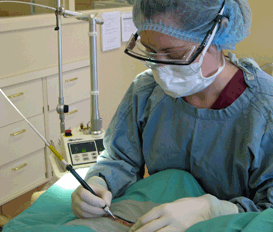
Our practice is pleased to offer the benefits of laser surgery to our patients.
As the laser passes through tissue, it seals off blood vessels, lymphatics, and nerve endings. This results in less bleeding during the surgical procedure, as well as less swelling, and, most importantly, less pain for the patient post-surgically.
Recovery times are often shortened when laser surgery is performed.